The American Lens: Why Japanese Tourists Are Now Following the Foreigners to Shimabara
Let's start with a scene that would have seemed absurd ten years ago.
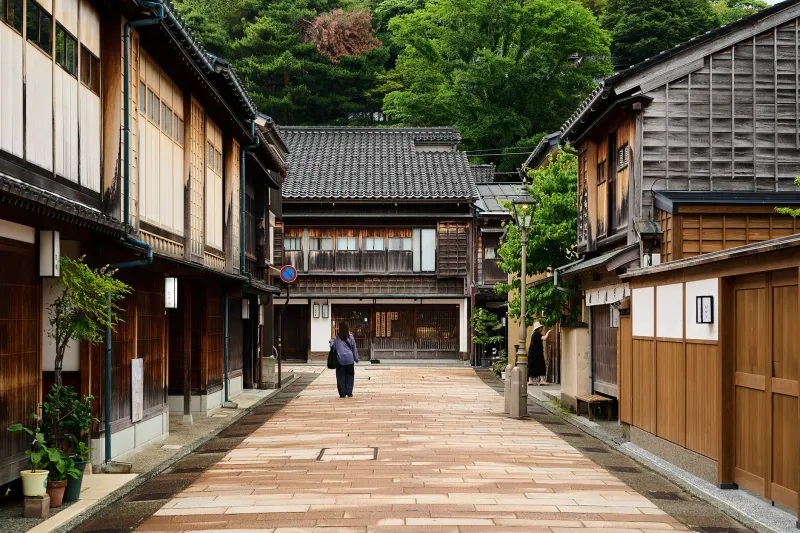
A group of travelers from Osaka is standing in front of a spring-water channel in Shimabara's old town — one of those quiet, moss-edged waterways that locals have walked past their entire lives without much ceremony. The Osaka visitors are taking photos. Careful, deliberate photos. One of them is writing something in a small notebook.
Ask them why they're here, specifically, and the answer is disarmingly direct: "American tourists kept posting about this place. We wanted to understand what they were seeing."
This is the Shimabara reverse tourism effect, and it's more philosophically loaded than it might first appear.
How It Started
Shimabara has never been a top-tier domestic tourism destination. Japanese travelers have historically gravitated toward Nagasaki city proper, or toward the more aggressively promoted onsen towns of Beppu and Yufuin. Shimabara was considered pleasant, historically interesting, and quietly appealing — the kind of place you might visit if you had family there.
Then American visitors started arriving in meaningful numbers, drawn by a combination of slow travel content, word-of-mouth from Japan enthusiasts, and a growing fatigue with over-touristed destinations. They wrote about Shimabara in ways that felt unfamiliar to Japanese readers — not as a list of historical facts, but as a sensory experience. The spring water. The volcanic silence. The feeling of time moving differently.
Domestic travel blogs and social media accounts started picking up this foreign coverage, and something shifted. Japanese travelers began arriving not to tick off a heritage site, but to understand what outsiders had found so compelling about a place they'd largely overlooked.
The Uncomfortable Truth About Familiarity
There's a concept in psychology sometimes called "the curse of knowledge" — the difficulty of seeing something clearly once you already know it well. For many Japanese travelers, domestic landmarks carry the weight of school trips, textbook familiarity, and cultural obligation. It's hard to experience wonder at something you've been told to appreciate since childhood.
Americans arriving in Shimabara carry none of that baggage. They don't know what they're "supposed" to think about the castle, or the Christian martyrdom history, or the volcanic disaster sites. They encounter these things with genuine openness, and that openness — expressed through photos, essays, and social media posts — reads as authenticity to Japanese audiences who have lost access to their own first-impression experience of these places.
"There's something almost embarrassing about it," admitted one travel blogger from Fukuoka who asked not to be named. "A foreigner comes here and writes about the sound of the water in the old samurai district, and I think — I grew up two hours from here and I never noticed that sound. What does that say about me?"
It says something true about all of us, honestly. Distance — cultural, geographical, psychological — creates the conditions for attention.
What This Means for Shimabara
The local tourism office is navigating this carefully. On one hand, the uptick in domestic visitors is genuinely welcome — Shimabara, like much of rural Japan, has faced population decline and economic pressure, and tourism revenue matters. On the other hand, there's a wariness about allowing the "American-approved" framing to become the dominant narrative about the peninsula.
"We don't want Shimabara to become a place people visit because foreigners told them to," said one local official, speaking generally about the community's sentiment. "We want people to come and find their own reasons."
This is a reasonable concern. There's a version of this story where the reverse tourism effect is just another layer of mediation — where Japanese visitors experience Shimabara through an American filter rather than a school-trip filter, and the place itself gets further buried under interpretation.
But there's another version, one that's more interesting and more hopeful.
The Mirror Works Both Ways
Several Japanese visitors interviewed in Shimabara described something unexpected: that coming to see what Americans saw ended up producing something more personal than that. The foreign perspective functioned as a kind of permission slip — a reason to look slowly, to ask questions, to sit somewhere without rushing.
"I came because of the American travel articles," said Hiromi Sato, a teacher from Kumamoto who visited with her husband last autumn. "But what I found was just... my own country. Things I'd stopped seeing. I don't think the Americans gave that to me. I think they reminded me to look."
That's the version of this story worth holding onto. Not Americans teaching Japanese people about Japan — that framing is as condescending as it sounds — but rather the way an outside perspective can shake loose the assumptions that familiarity builds up over time.
Shimabara, it turns out, is good at that. It has a way of slipping past whatever you think you know and showing you something you weren't expecting to find. Whether you arrive from Nashville or Nagasaki, the peninsula doesn't particularly care about your frame of reference.
It just asks you to pay attention.
And right now, for whatever complicated combination of reasons, more people are doing exactly that.